

The condition of the roads is one of the first visible signs of a municipality’s actions. Every day, residents of the town use the roads to get around, go to work, or access essential services. Well-maintained roads project an image of dynamism and good management, while dilapidated infrastructure can draw criticism and give the impression of neglect. This perception explains why road maintenance is often highlighted in term-of-office reviews.
The life cycle of infrastructure is a long-term process that doesn’t always align with the short timeframe of electoral mandates. The risk then becomes prioritizing immediate, superficial interventions at the expense of in-depth maintenance, which is less visible but crucial for the future.
This observation prompts a broader reflection: how can we meet residents’ expectations while ensuring the sustainable management of infrastructure ?
In many countries, road infrastructure is experiencing a kind of “asset crisis” which highlights the importance of public policies dedicated to “maintaining” existing infrastructure before creating new infrastructure. In recent years, social science research has identified various forms of this crisis and the questions it raises: in particular, how to understand, formalize and promote maintenance activities, and how to integrate them with the continuity of services? (1).
Roads, a visible marker of local public action
Road maintenance is a municipal investment whose effects are immediately visible to residents and road users. It responds to a strong expectation: to travel on safe and comfortable roads.
Some communities may then be tempted to intensify work at the end of their term, as elections approach.
When electoral logic weakens the maintenance strategy
Road maintenance is a recurring issue during election periods, but its management is a long-term undertaking. Proper maintenance of a road network is generally planned over 10 to 20 years, while elected officials typically think in terms of a 6-year term.
This discrepancy creates a dilemma: how to reconcile addressing the slow deterioration of infrastructure with the need to provide short-term, visible evidence of actions taken?
The long-term approach favored by the technical teams stems from the need to reduce “grey debt” meaning the accumulated backlog in road maintenance.
The longer preventive maintenance is postponed, the more deterioration worsens, making subsequent repairs far more costly and complex. When work is concentrated at the end of a term, roads that should have required preventive maintenance in the early years are neglected, deteriorate, and ultimately require more expensive renovations.
This creates a vicious cycle: a large portion of the budget is consumed by these major repairs, thus depleting the resources needed for preventive maintenance of the rest of the network.
In the long run, the municipality risks losing both budgetary efficiency and technical quality. This discrepancy illustrates the difficulty of aligning two timeframes: the electoral cycle and road maintenance.
Budgetary logics that are difficult to know precisely
Do elections truly influence municipalities’ investment choices? Do pre-election periods alter the priorities given to public works? These questions are central to debates on local governance. Analyses provide some answers, but they also reveal areas of uncertainty, particularly regarding road maintenance.
Is there really a link between elections and road maintenance?
Yes, analyses have shown a link between the electoral cycle and the pace of public investment (notably a report published in 2019 by INSEE (2) and more specifically on the activity of public works companies (3).
However, it remains difficult to know precisely to what extent the logic of asset management of roads is affected.
Several factors complicate the overall understanding of the financial effort devoted to roads. Small municipalities are generally less well-equipped with technical services, sometimes transfer road maintenance responsibilities to inter-municipal bodies but in various ways, and national surveys struggle to collect their feedback (4).
For a significant portion of the road network, the relative weight of electoral and technical considerations in asset management decisions is therefore poorly understood. Under these circumstances, local policies can aim to make the trade-offs between these criteria more transparent, including from one term to the next, provided they have adequate management tools (diagnosis, planning, monitoring, etc.).
How can these difficulties be overcome?
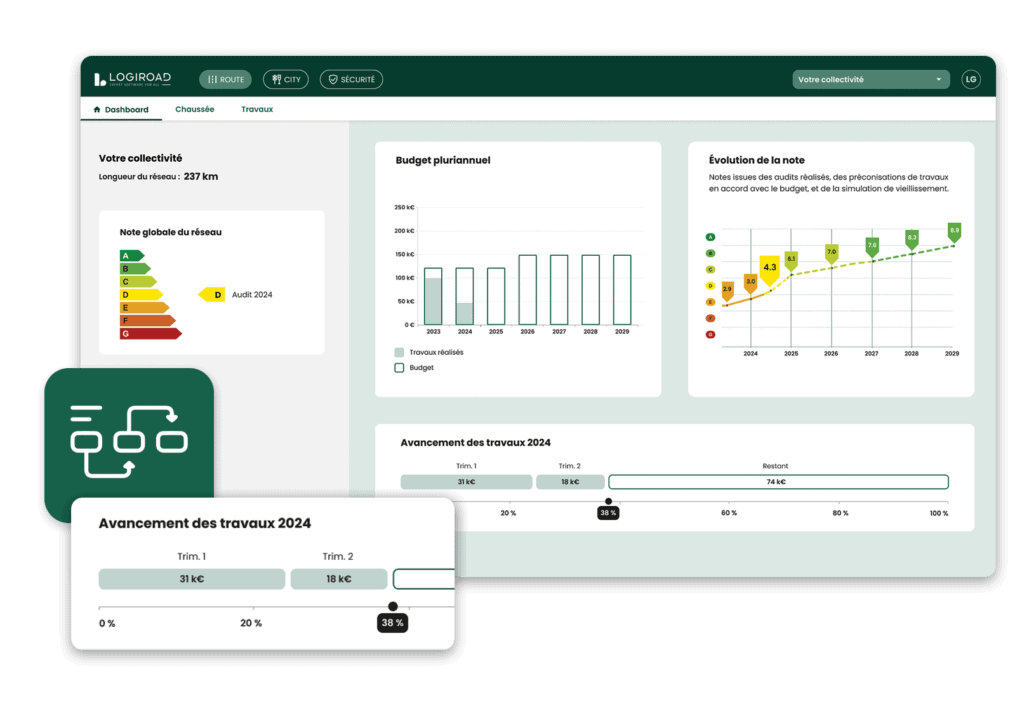
To move beyond ad hoc approaches and establish sustainable management, tools are needed that can create continuity between mandates. This is precisely what Logiroad offers.
Its solutions allow for diagnosing the condition of roads, simulating various customized budget scenarios, and planning interventions over several years based on the chosen strategy. This objective data helps elected officials justify their choices to residents and technical teams.
Logiroad also facilitates communication between elected officials and technical staff through shared dashboards and clear reports. This transparency is essential for establishing collaborative governance and preventing rifts between municipal teams. By integrating these solutions from the start of their term, municipalities can anticipate needs, optimize budgets, and demonstrate responsible management, even during election periods.
Towards shared and sustainable governance
Roads play a significant role in fostering support for a local development plan, as they serve as a visible indicator of public action. However, they should not be reduced to a mere electoral tool. They are an essential public service that deserves shared governance. Bringing all stakeholders (elected officials, technical experts, and partners) together is key to reconciling political effectiveness with territorial responsibility.
By adopting a collaborative approach and using appropriate tools, municipalities can transform roads into a collective project, ensuring both resident satisfaction and the long-term viability of road infrastructure.
Road infrastructure is an electoral issue, but above all it must be considered as a sustainable investment. Tools to support long-term asset management provide solutions for consolidating a relationship of trust between municipal teams, technical services and the public, based on data transparency and budget evaluation methods.
(1) Jérôme Denis et Daniel Florentin, 2022. « “Faire tenir” et entretenir les infrastructures ». Flux 129-130, 1-9.
(2) INSEE, 2019, Le cycle des élections municipales : Quels effets sur l’investissement public, l’emploi et la production
(3) Fédération Nationale des Travaux Publics, 06/2019 : Cycle municipal : quel impact sur l’activité TP ?
(4) IDDRIM, 2024. RAPPORT ONR 2024

Every project is unique.
Let’s discuss it together.