

Summary

In this interview, Philippe Lepert discusses his technical expertise in roadways, the creation of Logiroad as a co-founder, and the vision that still drives him today: supporting local authorities with reliable, accessible solutions designed based on the realities on the ground.
Retrouvez son interview vidéo à la fin de cet article !
Launch and creation of Logiroad
Can you introduce yourself?
“My name is Philippe Lepert, and I am a Civil Engineer specializing in Bridges and Roads.
From 1977 to 1984, I worked in Research and Development for various companies. In 1984, I joined the Central Laboratory for Bridges and Roads (LCPC), where I continued my research and development work.
From 1989 onward, I joined a group that managed road infrastructure, where I worked for about thirty years.
In 2012, Yann Goyat, another engineer from the LCPC, and I founded Logiroad, with the aim of making all the methods and IT tools we had developed at the Central Laboratory for Bridges and Roads available to road managers.”

You have dedicated more than 30 years to research on road maintenance. What motivated you to get involved in this field?
“Initially, it was purely by chance. A reorganization within the Central Laboratory led me to join the group focused on road maintenance management. I had no particular expertise in this area.
So I learned all the basics of the profession by visiting what were then called the Regional Laboratories of the Roads and Bridges Department, and by meeting with all the specialists in this field within these laboratories.
The discussions I had, both with these experts in the Regional Laboratories and with the network managers themselves, were pivotal, as it was there that I found, in a way, a way to express my passion for Research and Development.”
“It was first necessary to code these records using methods called MLPC, which I developed with my team, notably the method known as method 38-2, which is still used today.”
Philippe Lepert, co-founder of Logiroad
You supervised seven theses published between 1997 and 2012... What do you remember from those years of research?
“Over the years, I’ve had the opportunity to supervise, and even direct, half a dozen doctoral theses, many of which focused on identifying the patterns of pavement deterioration, observing how this deterioration and these defects evolve naturally when no maintenance is carried out.
To collect data that could then be processed using mathematical methods, it was first necessary to codify how pavement deterioration was recorded during inspections. This led us to define very rigorous methods to guide the work of those who recorded these pavement deteriorations.
In particular, these methods became part of a body of methods called “Methods of the French National Roads and Bridges Laboratory,” or “MLPC” for short.” And the one that is undoubtedly the most widely used today, and has been since that time, is the method for surveying road surface damage, known as method 38-2.”
In 2012, you co-founded the company Logiroad with Yann. What motivated this decision?
“We quickly realized at the Roads and Bridges Laboratory that the working environment, and particularly the administrative framework, didn’t allow us to adequately leverage the developments and tools we were creating to improve road maintenance and to assist road managers in their maintenance tasks.
This led Yann Goyat and me to conceive and create a company, which we called Logiroad. Its initial and primary goal was to promote the tools we had developed at the Central Laboratory by making them available and meeting directly with the road network managers for whom they were intended.
This was done both in France, at the national, departmental, and municipal levels, and abroad, where we worked in several small countries.”
In 2012, you co-founded the company Logiroad with Yann Goyat. What motivated this decision?
“We quickly realized at the Roads and Bridges Laboratory that the working environment, and in particular the administrative framework, did not allow us to sufficiently value the developments and tools we were creating to improve road maintenance. To help road managers in road maintenance.”
This led Yann Goyat and me to conceive and create a company, which we called Logiroad. Its initial and primary goal was to promote the tools we had developed at the Central Laboratory by making them available and directly engaging with the road network managers for whom they were intended.
This work took place both in France, at national, departmental, and municipal levels, and internationally, where we worked in several countries.”
“With Logiroad, our ambition was to democratize the technologies resulting from our research in order to help road managers make informed maintenance decisions.”
Philippe Lepert, co-founder of Logiroad
What was the initial objective in creating Logiroad?
“The primary objective was to ensure that the significant work we had conducted at the Central Laboratory for Bridges and Roads would be useful and therefore utilized by road authorities.
So we made all this work available to these authorities through the new Logiroad structure, which allowed us to contact and provide technical assistance directly to them, both in France, as I mentioned, and abroad.
The Central Laboratory didn’t allow its engineers to provide services abroad in the way that Logiroad enabled us to do.
It was extremely motivating and truly exciting to be able to work on road networks that were either European, but quite different from our own, or even more different in Africa, and later in Latin America.
It was a truly fascinating experience, which also showed us that the tools we developed within the LCPC framework were flexible enough to adapt to very different networks with very different contexts.
It was an enriching experience both personally and for Logiroad.”
How did you contribute to transforming years of research into a digital tool for road maintenance?
“It all unfolded in two stages: first, the creation of methods, as I mentioned, for data acquisition. This included recording road deterioration, measuring deformation, and assessing the mechanical resistance of pavements.
All these methods allowed us to codify this information, create databases from there, and finally, use this data to streamline road maintenance management.
This progressive work, first in developing methods, then in computerization, led to the professional tools we made available to network managers.”

How did you contribute to transforming years of research into a digital tool for road maintenance?
“It all unfolded in two stages: first, the creation of methods, as I mentioned, for data acquisition. This included recording road deterioration, measuring deformation, and assessing the mechanical resistance of pavements.
All these methods allowed us to codify this information, create databases from there, and finally, use this data to streamline road maintenance management.
This progressive work, first in developing methods, then in computerization, led to the professional tools we made available to network managers.”
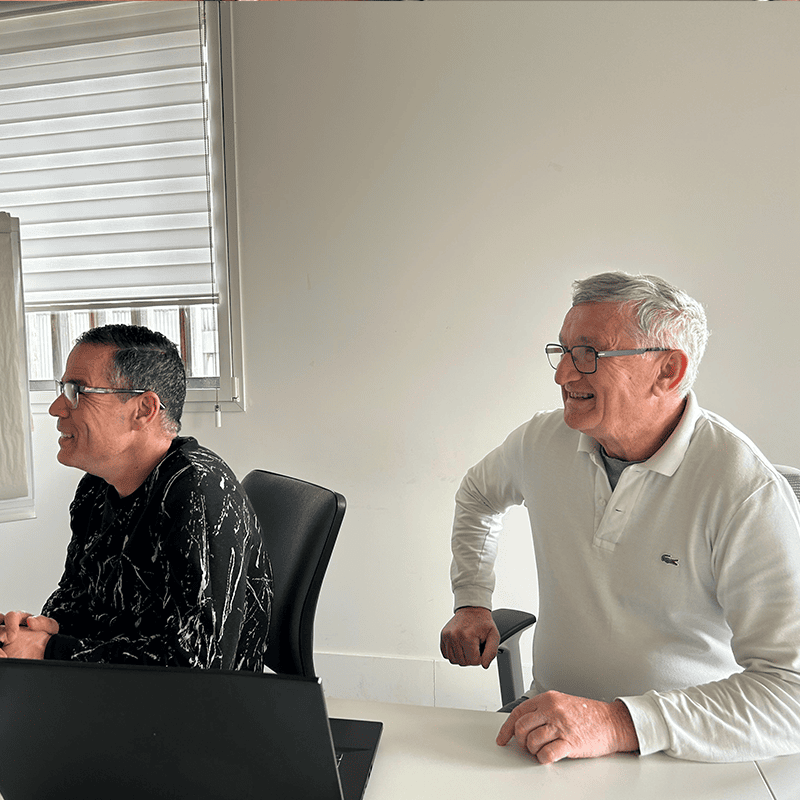
What were the biggest challenges in launching the first software in 2016?
“The main challenge was getting the road maintenance departments to adopt our methods. Many were very attached to their old work habits, and switching them to specialized software wasn’t easy. But by using the tools themselves, they were able to see the reliability of the methods and the time savings they achieved, which gradually convinced them.”
What were the biggest challenges in launching the first software in 2016?
“The main challenge was getting the road maintenance departments to adopt our methods. Many were very attached to their old work habits, and switching them to specialized software wasn’t easy. But by using the tools themselves, they were able to see the reliability of the methods and the time savings they achieved, which gradually convinced them.”
Anecdotes and highlights
Can you share a memorable moment from your early days with Logiroad?
“A defining moment was our very first sale to a local authority in the Pas-de-Calais department (62). This truly launched Logiroad. Very quickly, another important milestone followed with our first sale abroad, in Mali. These initial successes confirmed that our solutions met a real need for road managers, both in France and internationally.”
"These initial successes have confirmed that our solutions meet a real need for road managers, both in France and internationally."
Philippe Lepert, co-founder of Logiroad
How do you see the future of road management in 10 years?
“Something that seems to be increasingly emerging is the use of Artificial Intelligence thanks to the road databases we have compiled.
Therefore, we can expect that applying Artificial Intelligence to the analysis of these databases—and we are working on it—should lead to progress.
However, it is certain that human expertise will remain the very foundation of this technical field and that it will be supported and enhanced by Artificial Intelligence algorithms that will allow it to work faster, more safely, and more reliably.”
What message would you like to convey to communities discovering Logiroad?
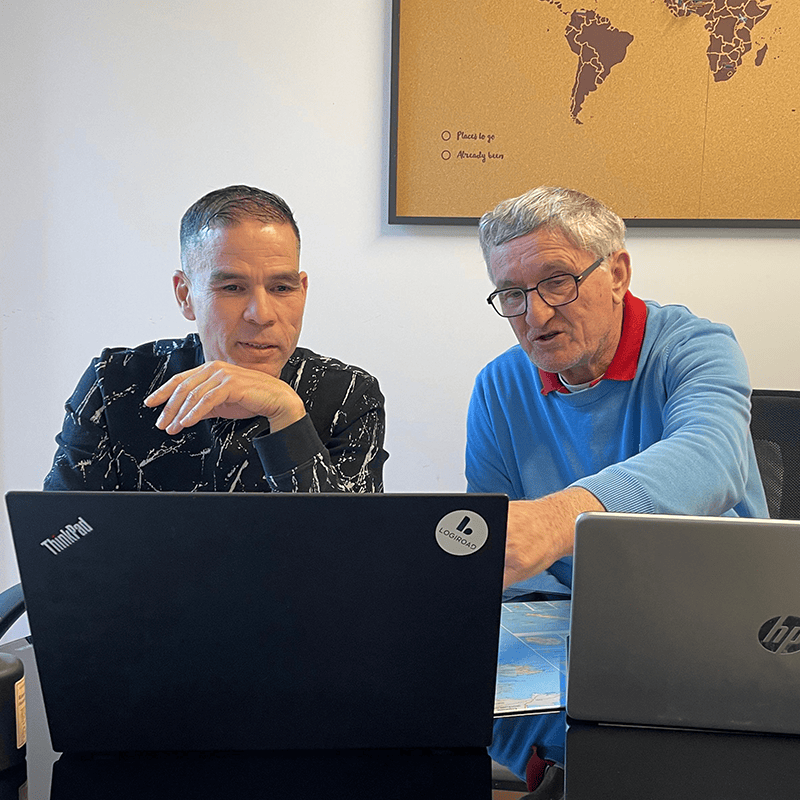
“The message is quite simple: thanks to our thirty years of expertise in the field of roads, we are able to provide very substantial support to these managers in the performance of their duties.
It is our very mission to provide this support by listening to them. By listening to their needs, which may evolve, and by providing the most relevant solution each time.”

How do you see the future of road management in 10 years?
“Something that seems to be increasingly emerging is the use of Artificial Intelligence thanks to the road databases we have compiled.
Therefore, we can expect that applying Artificial Intelligence to the analysis of these databases—and we are working on it—should lead to progress.
However, it is certain that human expertise will remain the very foundation of this technical field and that it will be supported and enhanced by Artificial Intelligence algorithms that will allow it to work faster, more safely, and more reliably.”
What message would you like to convey to communities discovering Logiroad?
“The message is quite simple: thanks to our thirty years of expertise in the field of roads, we are able to provide very substantial support to these managers in the performance of their duties.
It is our very mission to provide this support by listening to them. By listening to their needs, which may evolve, and by providing the most relevant solution each time.”
What is Logiroad?
If you had to summarize Logiroad in three words, which would you choose?
“Expertise, road infrastructure, and IT. The very core of Logiroad’s business is combining these three areas.
Technical expertise, applied to the road infrastructure sector and implemented using the IT resources available today.”
What is your greatest source of pride in this adventure?
“It’s quite simple: we’ll soon be fifteen years since we created Logiroad, and the company is still going strong and remains very active in its technical niche.
It’s undoubtedly this longevity and growth over fifteen years that makes me most proud of what we accomplished back then.”
Theses and contributions of Philippe Lepert:
Philippe Lepert, Yves Savard, Diane Leroux, Michel Reche, 2004. « Méthodes statistiques de prévision de l’évolution d’une chaussée ».
Hussein Khraibani 2010. « Modélisation statistique de données longitudinales sur un réseau routier entretenu »
Fabien Menant, 2014 « Estimation de l’uni longitudinal des infrastructures routières au moyen de véhicules traceurs »
Anne de Bortoli, 2019, « Pour un entretien routier durable : prise en compte des conséquences de l’interaction chaussée-véhicule dans l’aide à la décision des politiques de resurfaçage – illustration par un cas autoroutier français »

Every project is unique.
Let’s discuss it together.