

Saving time without losing accuracy: this is the challenge Logiroad takes on by placing artificial intelligence (AI) at the heart of its road audit strategy. A look back at a tangible innovation, made in France, that is revolutionising road maintenance.
AI, a lever to better maintain roads
Road managers face a dual challenge: monitoring a heterogeneous and ageing road network while optimising increasingly constrained maintenance budgets. Artificial intelligence proves to be a valuable tool here for detecting road deterioration more quickly, allowing our pavement engineers to focus on the added value of Logiroad: the personalised, realistic, and achievable multi-year maintenance programme. These work recommendations are based on our algorithms of work impact laws and pavement ageing laws, allowing a refined vision of the future state of road infrastructures.
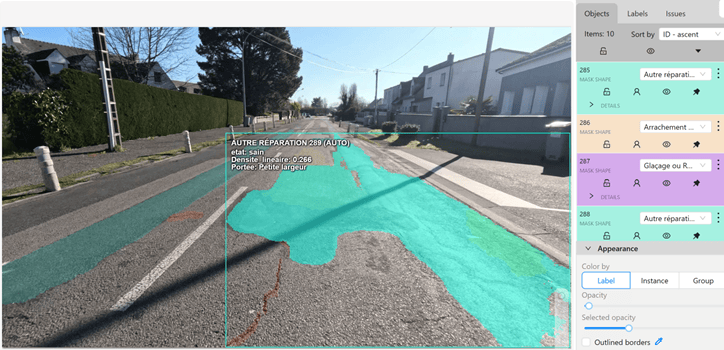
At Logiroad, AI automatically analyses images collected in the field. It detects defects such as cracks, road crazing, repairs or potholes with 90% accuracy. Once identified, these defects are classified, geolocated, and integrated into our mapping platform: Logiroad Center. It provides an up-to-date and objective overview of the road network’s condition.
An AI trained in the field
At Logiroad, AI is not outsourced: it is developed in-house by a dedicated team, working closely with the field. Our teams specialised in artificial intelligence, for example, play a key role in training AI models using real data from vehicles equipped with cameras and expert sensors.
Each image is initially annotated manually by several trained annotators using a defect library developed by our experts. These images, reviewed by the experts, thus form an “expert consensus” knowledge base. This represents more than 20,000 images. AI is then trained on this database and is able to detect and recognise all types of defects in all contexts (lighting, orientation, location, etc.) in a reproducible manner, as our expert committee would have done.
Different AI for different levels of recognition
Unlike other players in the sector, Logiroad has made the strategic choice to use pixel-by-pixel segmentation, rather than simple bounding box detection, commonly used in computer vision.
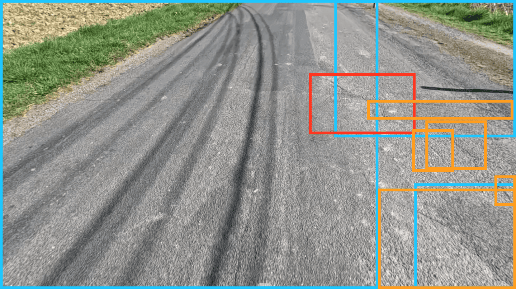
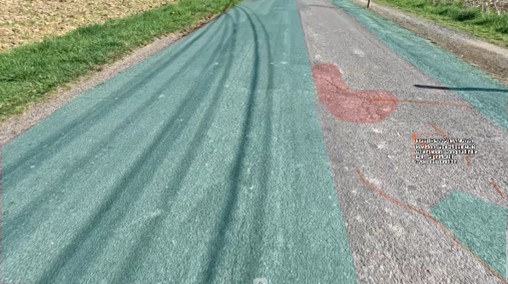
The fine segmentation models developed by Logiroad identify each pixel that truly belongs to the crack or anomaly. Indeed, a pixel can belong to multiple “classes.” For example, a pixel can belong both to “bleeding” and a “longitudinal trench.” This thus provides detailed information on:
- The typology of degradation (cracks, crazing, tearing, etc.)
- The state of deterioration (degraded, very degraded, etc.) ;
- The orientation of the defect in relation to the track axis ;
- The position on the roadway, essential for diagnosing structural causes ;
- The affected area, essential for quantifying the repairs.
This precision greatly enhances the relevance of maintenance recommendations, while paving the way for more reliable predictive analyses. It is this technological requirement that allows Logiroad to provide road managers with actionable diagnostics and a customised work programme, tailored to their operational constraints.
AI as an accelerator, humans as builders
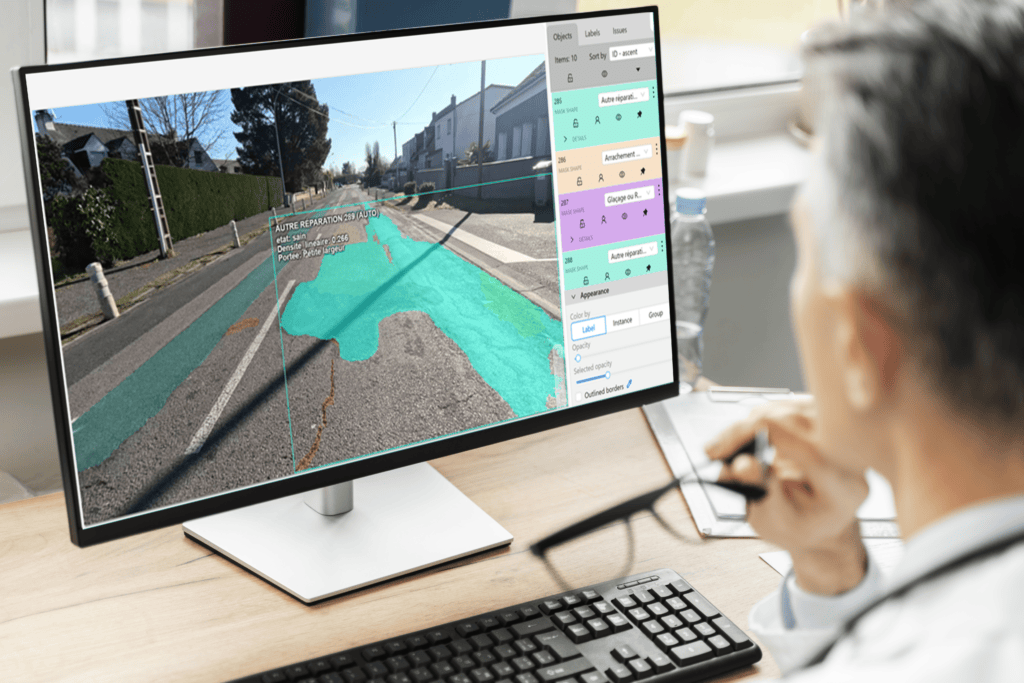
The current omnipresence of artificial intelligence in technological debates has prompted us to clarify its exact role within our professions. Logiroad has been developing its software for over 10 years. We recognise the crucial contribution of our road engineers in designing and defining our tools. And because we come from the road before technology, we can only embrace the current technological revolution. But let’s be clear, AI will never repair roads. Our vision is one of a partnership between AI and road engineering, hand in hand, serving local authorities.
If we chose the demanding approach of pixel-by-pixel segmentation rather than bounding boxes, it is not to fuel a “all AI” narrative, but to provide data of great accuracy on the surface area and the real typology of the degradations. However, this cutting-edge technology does not make us “better” than before; it primarily helps us work faster in the face of the increasing number of national and international projects.
At Logiroad, we talk little about our AI because it remains a tool serving a much more concrete purpose: delivering a multi-year programme of personalised, realistic, and achievable maintenance work. AI frees up time for our engineers and local authorities so they can focus on what matters — maintenance strategy and action on the ground.
AI is a companion in detection, but it is humans who decide and repair.

Every project is unique.
Let’s discuss it together.